Summer
The Curious Incident of the Dog in the Night-TimeSummer is a recurring time of solitude and expansive looking in Christopher’s account: it lets him imagine himself alone in the world, project himself into space, and find perspective beneath a real night sky. These scenes connect the season not simply with warmth, but with a chosen distance from ordinary surroundings and the problems they contain.
Nighttime Solitude
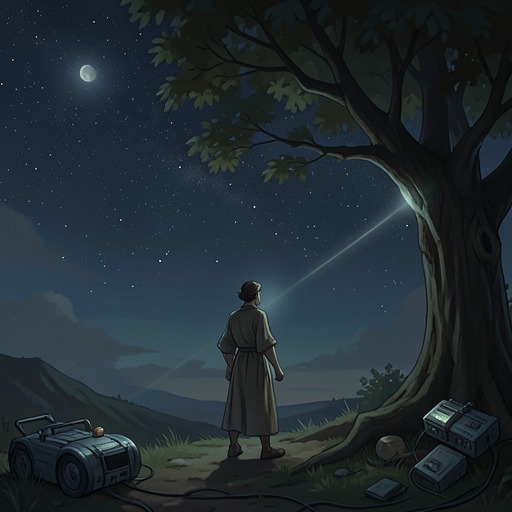
When Christopher describes feeling happy, he recalls staying awake at three or four in the morning and walking up and down the street, pretending to be the only person in the whole world. Summer makes that image especially tangible in another account: he sometimes lies on the lawn at night and looks up at the sky, using his hands to block out the fence, chimney, and washing line so that he can pretend to be in space. The ordinary garden is not removed; he deliberately screens its familiar objects from view.
The Imagined Spacecraft
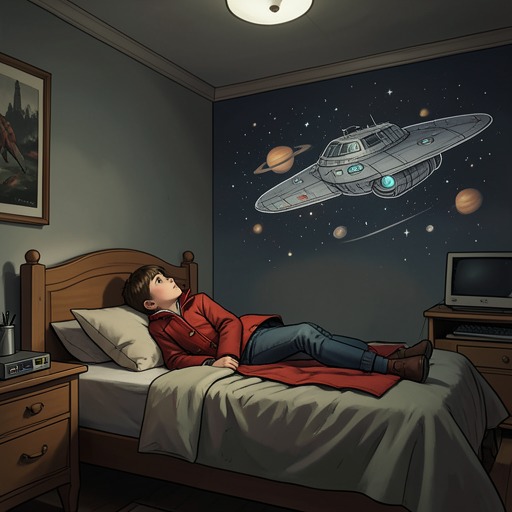
Space extends this summer fantasy into a more elaborate picture of life beyond Earth. Christopher imagines that a spacecraft would suit him because it would be filled with machines, computers, and outer space, and because he would not be homesick. Contact with Mission Control through a radio link and television monitor would make other people feel less like strangers, more like participants in a computer game. A spacecraft would also contain none of the yellow or brown things he dislikes. Its small window would look onto thousands of miles of distance, turning the solitude he rehearses on the lawn into a literal condition.
The imagined journey remains connected to attachment as well as escape: Christopher would like to bring Toby with him. He considers whether an experiment involving a rat could persuade others to allow it, but insists that it must not hurt Toby. The fantasy of isolation therefore has a specific exception: the animal he cares for could accompany him, provided his safety is protected.
The Summer Sky and Perspective
In a later garden night, Christopher looks at the sky with a planisphere, a rotating pair of plastic circles joined by a pin. Its aperture aligns a map of the sky with the date and the latitude of Swindon, 51.5 degrees north. The instrument gives the sky an ordered, usable form: by turning it, he can identify what is visible from his location on that day of the year.
The stars also widen his sense of time and scale. Their light has travelled hundreds or thousands of light-years, so some stars may already have died or exploded before their light reaches him. Christopher knows that matter essential to life was made in stars, including the iron in blood. Against this immense distance and deep time, he can regard difficult circumstances as negligible—so small that they need not enter a calculation. Summer’s night sky thus offers both precise observation and a way to set immediate troubles within a much larger frame.